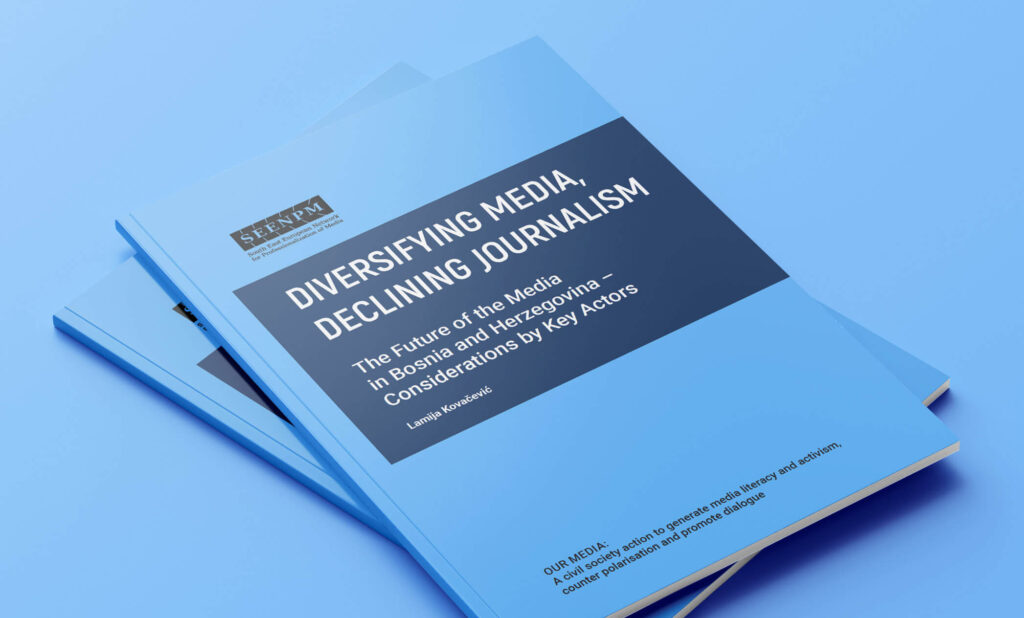
Summary of Considerations by Key Actors
Diversifying Media, Declining Journalism
The ongoing crisis of freedom, quality, and legitimacy facing the media in Bosnia and Herzegovina deepened in 2025, as the environment for independent and free journalism further eroded due to systemic political pressures, financial instability, and declining public trust. Media outlets are widely perceived as politically captured, operating in an environment where professional journalists have been largely sidelined and continue to face severe constraints on their freedoms.
This continuation of the Future of Media study builds on previous findings through analysis of qualitative data collected through focus groups with citizens, media professionals, and citizens with high social and cultural capital and influence. Participants in this study described a media system that fails to inform the public effectively, ensure accountability, or offer a space for deliberation—thus failing to uphold the fundamental roles of media in a democratic society.
The findings point to a fragmented environment, shaped by both global trends and domestic particularities. The media landscape reflects global phenomena such as digital disruption, algorithmic segmentation, and the erosion of shared information spaces. At the same time, it is further fractured by political, ethnic, and ideological polarization of the media in BiH, as well as by divergent policies across the country’s complex administrative structure.
Journalists in Bosnia and Herzegovina face increasing attacks and pressures, now increasingly reflected in the policy environment, particularly in Republika Srpska, where intensified efforts to introduce a “foreign agents law” signal further democratic regression following the re-criminalization of defamation. Media professionals’ reflections on trends from previous research largely affirmed the earlier findings, emphasizing the growing financial strain caused by the withdrawal or reduction of major international donor funding, as well as the resulting closure and downsizing of affiliated newsrooms.